NOW AVAILABLE! Launch your AI-as-a-service business with Hatz Activate!
Learn more
NOW AVAILABLE! Launch your AI-as-a-service business with Hatz Activate!
Learn more
NOW AVAILABLE! Launch your AI-as-a-service business with Hatz Activate!
Learn more
Your 2026 AI Adoption Roadmap
Your 2026 AI Adoption Roadmap
Hatz AI
A Practical Framework for Moving from Experiments to Results
Where You Are Today
You've started experimenting with AI. Maybe you have a Hatz AI license, or you've run a few pilots. Some team members are enthusiastic, others are skeptical.
Here's what we see happening:
✅ A few power users getting value
❌ Most of the team not using AI daily
❌ No clear path from experiments to real business outcomes
❌ Concerns about security, governance, and data handling
❌ Uncertain ROI and no way to measure impact
Sound familiar?
You're not alone. Research from OpenAI shows that most organizations are stuck in exactly this spot—pilot purgatory.
The companies that break through treat AI differently. They follow a structured path from experimentation to adoption to transformation.
This framework is that path.
Over the next 90 days, we'll help you move through four gates. Each gate has clear success criteria, practical actions, and measurable outcomes.
By the end, AI won't be an experiment. It will be how your team works.
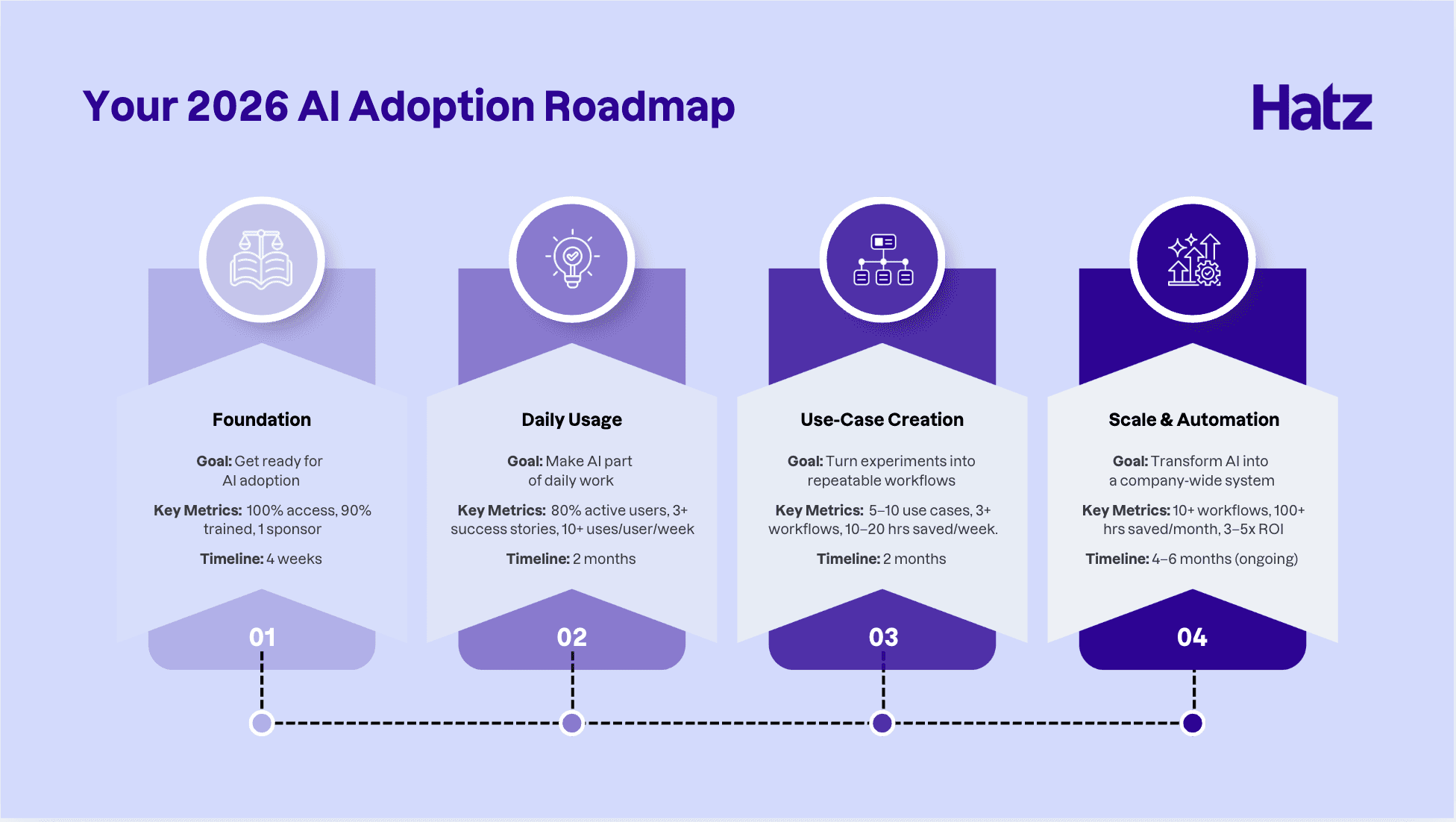
The Four-Gate Framework
How to Read This Framework
Each gate includes:
🎯 Goal: What you're trying to achieve
📋 Success Criteria: How you know you've cleared the gate
⚙️ What We'll Do Together: Practical actions we'll take
📊 Metrics That Matter: How we measure progress
⏱️ Timeline: How long this typically takes
Let's walk through each gate.
Gate 1: Foundation
🎯 Goal: Get your organization ready for AI adoption
This isn't about picking use cases yet. It's about creating the environment where AI can succeed—secure access, clear guidelines, and basic training for your team.
📋 Success Criteria: What "Done" Looks Like
✅ Every employee has secure access to AI tools
✅ Leadership has communicated the vision and expectations
✅ All staff completed AI Certification training (40-50 minutes)
✅ Clear guidelines exist for what's safe and what's not
✅ At least one executive sponsor actively championing AI
✅ Basic governance framework in place
⚙️ What We'll Do Together
Week 1: Setup & Security
Deploy secure AI environment for your organization
Configure user access and permissions
Set up data governance controls
Establish security protocols
Week 2: Leadership Alignment
Executive briefing on AI strategy
Identify executive sponsor(s)
Create internal communication plan
Define success metrics for your organization
Week 3: Team Training
Roll out "AI Certification" training
Cover: What AI can/can't do, when to use it, data safety
Hands-on exercises with real work scenarios
Q&A session to address concerns
Week 4: Guidelines & Launch
Publish AI usage guidelines
Launch internal communications
Set up support channels (how to get help)
Celebrate early adopters
📊 Metrics That Matter
100% of employees have access
90%+ complete foundational training
1 executive sponsor identified and active
1 set of usage guidelines published and distributed
⏱️ Timeline: 4 Weeks
Why This Matters: Organizations that skip foundation work hit adoption walls within weeks. People won't use AI if they're unsure whether it's safe, allowed, or worth their time.
Gate 2: Daily Usage
🎯 Goal: Make AI part of your team's daily rhythm
This is where most organizations fail. They launch AI access but don't build the habits that lead to fluency. This gate is about turning occasional experiments into daily practice.
📋 Success Criteria: What "Done" Looks Like
✅ 80% of employees have used AI at least 5 times
✅ Each team can name 2-3 tasks where AI saves them time
✅ AI usage is part of weekly team discussions
✅ Internal champions identified in at least 3 departments
✅ Success stories being shared across the organization
✅ Leadership actively modeling AI usage
⚙️ What We'll Do Together
Kickstart Daily Habits
Launch "5-a-Day Challenge" (5 AI interactions per day)
Provide department-specific prompt templates
Set up peer learning groups
Host weekly "AI Office Hours" for questions
Build Momentum
Identify and empower AI champions (1-2 per department)
Create "Success Story" template for sharing wins
Run mini-workshops by department (sales, operations, support, etc.)
Share best practices across teams
Embed the Habit
Integrate AI into existing workflows and meetings
Have managers ask: "Where did AI help you this week?"
Document time-saving examples
Celebrate progress and recognize champions
📊 Metrics That Matter
80%+ active users (logged in and used AI 5+ times)
3-5 documented success stories with time savings
3+ internal champions identified and trained
Average usage: 10+ AI interactions per user per week
Team confidence: Survey shows 70%+ feel comfortable using AI for daily tasks
⏱️ Timeline: 8 Weeks (2 Months)
Why This Matters: AI's ROI compounds over time. But compounding only starts when usage becomes daily. This gate transforms AI from "something we have" to "something we do."
Gate 3: Use-Case Creation
🎯 Goal: Turn experiments into repeatable workflows
Once your team is fluent, something special happens—they start spotting opportunities everywhere. This gate is about capturing those ideas, prioritizing them, and building the workflows that deliver measurable business value.
📋 Success Criteria: What "Done" Looks Like
✅ 5-10 high-value use cases identified and documented
✅ Each use case has a clear owner and timeline
✅ At least 3 workflows are built and repeatable
✅ Measurable outcomes documented (time saved, accuracy improved)
✅ Early wins communicated across the organization
✅ Process established for capturing new ideas
⚙️ What We'll Do Together
Capture & Prioritize
Run "AI Adoption Workshop" with your leadership team
Collect use case ideas from across the organization
Score each by: Impact (high/med/low) × Effort (high/med/low)
Select top 5-10 use cases to develop
Assign ownership for each
Build & Prototype
Build workflows for top 3 use cases
Test with small pilot groups (5-10 users)
Gather feedback and iterate
Document the workflow (so others can replicate)
Calculate time/cost savings
Share & Scale
Roll out successful workflows to broader teams
Create "How-To" guides for each workflow
Present results to leadership
Celebrate teams who contributed ideas
Launch intake process for new use cases
📊 Metrics That Matter
5-10 use cases documented with clear ROI
3+ workflows deployed and actively used
10-20 hours saved per week (measurable)
$X,XXX in cost savings or new revenue identified
90%+ satisfaction from pilot users
⏱️ Timeline: 8 Weeks (2 Months)
💡 Example Use Cases by Department
Sales:
✅ Automated proposal generation (saves 3 hours per proposal)
✅ Pre-call research briefings (saves 30 min per meeting)
✅ Personalized email campaigns (2x response rate)
Operations:
✅ Invoice processing automation (reduces errors by 80%)
✅ Vendor analysis and comparison (saves 5 hours per quarter)
✅ SOP creation from video recordings (saves 2 hours per doc)
Customer Support:
✅ Tier 1 response templates (reduces response time by 50%)
✅ Customer sentiment analysis (identifies at-risk accounts early)
✅ Knowledge base auto-updates (keeps docs current)
Marketing:
✅ Content repurposing (1 blog → 10 social posts in 15 minutes)
✅ Campaign performance analysis (weekly instead of monthly)
✅ Competitor monitoring summaries (daily insights)
🎯 How to Prioritize Use Cases
We'll use this simple framework:
Use Case | Impact | Effort | Score | Priority |
Proposal automation | High | Low | 9 | P1 |
Customer response templates | High | Low | 9 | P1 |
Invoice processing | Med | Med | 6 | P2 |
Content repurposing | Med | Low | 7 | P2 |
Competitor analysis | Low | High | 3 | P3 |
Priority 1 (P1): High impact, low effort → Build immediately
Priority 2 (P2): Medium value → Build next quarter
Priority 3 (P3): Park for future consideration
Why This Matters: This is where AI stops being an experiment and starts delivering measurable business value. You'll have concrete examples to point to: "AI saved us 40 hours last month" or "Our proposal close rate increased by 15%."
Gate 4: Scale & Automation
🎯 Goal: Transform AI from project to operating system
You've proven AI works. Now it's time to scale—integrate with your core systems, automate high-value processes, and make AI a competitive advantage.
📋 Success Criteria: What "Done" Looks Like
✅ AI integrated with core systems (email, CRM, document storage)
✅ 10+ workflows running across the organization
✅ Measurable ROI: time saved, costs reduced, revenue increased
✅ AI champions in every department
✅ Systematic process for continuous improvement
✅ Customer-facing AI capabilities deployed (optional but powerful)
⚙️ What We'll Do Together
Integration & Automation
Connect AI to your email system (Microsoft 365 / Google Workspace)
Integrate with CRM (Salesforce, HubSpot, etc.)
Connect to document repositories (SharePoint, Google Drive)
Automate high-volume, repeatable workflows
Set up API connections for custom use cases
Governance & Measurement
Formalize company-wide AI policy
Establish AI governance committee
Deploy ROI tracking dashboard
Create feedback loops for continuous improvement
Document lessons learned
Optimization & Growth
Expand successful workflows to new teams
Build customer-facing AI capabilities
Train "AI Center of Excellence" team
Plan next wave of automation
Share success story externally (marketing, recruiting)
📊 Metrics That Matter
10+ workflows in production
100+ hours saved per month (measurable)
$XX,XXX in documented cost savings or new revenue
3-5 core systems integrated
ROI: 3-5x return on AI investment
Team satisfaction: 80%+ of employees say AI makes their job easier
⏱️ Timeline: 4-6 Months (Ongoing)
💡 What Scale Actually Looks Like
Integration Examples:
Email: Auto-draft responses to common inquiries
CRM: Auto-update contact records from meeting notes
Documents: Auto-generate reports from data sources
Scheduling: AI assistant handles meeting coordination
Support: AI triage and draft responses to tickets
Customer-Facing Examples:
AI-powered chatbot on your website
Automated proposal generation for prospects
Intelligent product recommendations
Predictive maintenance alerts for clients
Personalized customer communications at scale
📈 Sample ROI Dashboard (What We'll Track Together)
Metric | Baseline | Current | Change | Value |
Time saved/month | 0 hrs | 120 hrs | +120 hrs | $6,000 |
Support response time | 4 hours | 30 min | -87% | Better CX |
Proposal close rate | 22% | 31% | +9% | $45K/mo |
Employee satisfaction | 65% | 82% | +17% | Better retention |
Total Monthly Value |
|
|
| $51K+ |
Why This Matters: At this gate, AI becomes a competitive advantage. You're not just saving time—you're delivering better customer experiences, making faster decisions, and building capabilities your competitors don't have.
Your 6-Month Roadmap at a Glance
Month 1: Foundation
├─ Setup secure environment
├─ Train all staff (Level 1)
├─ Launch usage guidelines
└─ Identify executive sponsor
Month 2-3: Daily Usage
├─ Build daily AI habits (80% active users)
├─ Identify champions
├─ Share success stories
└─ Hit 10+ uses per user/week
Month 4-5: Use-Case Creation
├─ Capture 10 use cases
├─ Build 3 workflows
├─ Measure time/cost savings
└─ Scale successful workflows
Month 6+: Scale & Automation
├─ Integrate core systems
├─ Deploy 10+ workflows
├─ Track ROI ($XX,XXX saved)
└─ Build customer-facing capabilities
What You Can Expect from Us
As your AI implementation partner, here's what we commit to:
✅ Strategic Guidance
Quarterly business reviews to assess progress
Benchmarking against similar organizations
Recommendations for next phase
Industry best practices and trends
✅ Technical Implementation
Secure platform setup and management
System integrations (email, CRM, etc.)
Workflow development and testing
Ongoing platform optimization
✅ Training & Enablement
Structured training programs
Department-specific workshops
Champion training and support
Ongoing "AI Office Hours"
✅ Measurement & Reporting
Monthly usage reports
ROI tracking dashboard
Success story documentation
Executive summaries
✅ Continuous Support
Dedicated support channels
Regular check-ins
Problem-solving sessions
Access to AI experts
What We Need from You
For this framework to succeed, we need your partnership:
✅ Executive Sponsorship
Visible support from leadership
Regular communication about AI vision
Resources allocated (time, budget)
Willingness to model AI usage
✅ Champion Network
1-2 champions per department
Time allocated for learning and experimentation
Permission to share wins and learnings
Enthusiasm for change
✅ Feedback & Iteration
Honest feedback about what's working
Willingness to try new approaches
Participation in workshops and reviews
Ideas for use cases and improvements
✅ Patience & Persistence
Understanding that fluency takes practice
Commitment to the full framework (not just Gate 1)
Acceptance that some experiments won't work
Long-term perspective on ROI
Common Questions
"How much time will this take?"
For most employees: 2-3 hours in Month 1 (training + setup), then 15-30 minutes per day using AI in their normal work.
For champions: Additional 2-4 hours per month for workshops, sharing learnings, and helping teammates.
For leadership: 1 hour per month for reviews and strategic discussions.
"What if some team members resist?"
That's normal. We'll focus on:
Early wins: Show quick time savings
Champions: Let enthusiasts lead the way
Safe space: Make it okay to experiment and fail
Relevance: Connect AI to their specific job frustrations
By Month 3, most skeptics become believers when they see real results.
"How do we measure ROI?"
We'll track:
Time saved (hours per week/month)
Cost savings (reduced manual work, fewer errors)
Revenue impact (faster sales cycles, better customer retention)
Quality improvements (accuracy, consistency, customer satisfaction)
Competitive advantage (capabilities competitors don't have)
"What if we're already using AI tools?"
Great! We'll assess where you are and meet you there. Many organizations:
Have ChatGPT but lack governance → Start at Gate 1
Have daily users but no workflows → Jump to Gate 3
Need to audit and optimize existing use → Focus on Gate 4
"How is this different from just buying ChatGPT licenses?"
ChatGPT is a tool. This framework is the system that ensures the tool gets used effectively:
Security & Governance: Enterprise controls, not consumer accounts
Structure: Clear path from experiments to business impact
Training: Built-in certification and workshops
Integration: Connected to your existing systems
Measurement: Track ROI and usage
Support: We're with you every step
Success Stories: What This Looks Like in Practice
Manufacturing Company (45 employees)
Timeline: 5 months from start to scale
Gate 1-2 (Months 1-2)
Deployed Hatz AI, trained all staff
82% hit daily usage by Week 8
Gate 3 (Months 3-4)
Built workflows for: Quote generation, vendor analysis, safety documentation
Saved 35 hours/week across teams
Gate 4 (Month 5+)
Integrated with Dynamics 365 CRM
Automated quote-to-order process
Result: 28% faster quote turnaround, $78K saved annually
Professional Services Firm (28 employees)
Timeline: 6 months from start to scale
Gate 1-2 (Months 1-3)
Slower adoption due to client concerns
Focused on internal operations first
Hit 75% daily usage by Month 3
Gate 3 (Months 4-5)
Built workflows for: Client reports, proposal writing, research summaries
Consultants saved 8 hours/week on admin tasks
Gate 4 (Month 6+)
Integrated with Salesforce
Built client-facing AI capabilities
Result: 8 hours per consultant returned to billable work = $156K additional revenue annually
Next Steps
Ready to move from AI experiments to AI impact?
Step 1: Alignment Meeting (1 hour)
We'll discuss:
Where you are today
Your goals for AI adoption
Your timeline and constraints
Questions and concerns
Step 2: Customized Roadmap (We create this)
Based on our discussion, we'll tailor this framework:
Adjusted timeline based on your team size
Customized use cases for your industry
Training schedule that fits your calendar
Success metrics specific to your business
Step 3: Executive Briefing (30-45 minutes)
We'll present to your leadership team:
The framework and timeline
Expected outcomes and ROI
What we need from leadership
Answers to their questions
Step 4: Launch Gate 1 (Week 1)
We hit the ground running:
Deploy secure AI environment
Schedule training sessions
Identify executive sponsor
Begin the journey

Let's Build Your AI Future Together
The companies winning with AI in 2025 aren't running longer pilots. They're building fluency faster.
This framework gives you the roadmap. We'll be your guide.
Ready to get started?

This framework is based on research from OpenAI's "From Experiments to Deployments" whitepaper and refined through dozens of successful implementations with businesses like yours.
Your 2026 AI Adoption Roadmap
Hatz AI
A Practical Framework for Moving from Experiments to Results
Where You Are Today
You've started experimenting with AI. Maybe you have a Hatz AI license, or you've run a few pilots. Some team members are enthusiastic, others are skeptical.
Here's what we see happening:
✅ A few power users getting value
❌ Most of the team not using AI daily
❌ No clear path from experiments to real business outcomes
❌ Concerns about security, governance, and data handling
❌ Uncertain ROI and no way to measure impact
Sound familiar?
You're not alone. Research from OpenAI shows that most organizations are stuck in exactly this spot—pilot purgatory.
The companies that break through treat AI differently. They follow a structured path from experimentation to adoption to transformation.
This framework is that path.
Over the next 90 days, we'll help you move through four gates. Each gate has clear success criteria, practical actions, and measurable outcomes.
By the end, AI won't be an experiment. It will be how your team works.
The Four-Gate Framework
How to Read This Framework
Each gate includes:
🎯 Goal: What you're trying to achieve
📋 Success Criteria: How you know you've cleared the gate
⚙️ What We'll Do Together: Practical actions we'll take
📊 Metrics That Matter: How we measure progress
⏱️ Timeline: How long this typically takes
Let's walk through each gate.
Gate 1: Foundation
🎯 Goal: Get your organization ready for AI adoption
This isn't about picking use cases yet. It's about creating the environment where AI can succeed—secure access, clear guidelines, and basic training for your team.
📋 Success Criteria: What "Done" Looks Like
✅ Every employee has secure access to AI tools
✅ Leadership has communicated the vision and expectations
✅ All staff completed AI Certification training (40-50 minutes)
✅ Clear guidelines exist for what's safe and what's not
✅ At least one executive sponsor actively championing AI
✅ Basic governance framework in place
⚙️ What We'll Do Together
Week 1: Setup & Security
Deploy secure AI environment for your organization
Configure user access and permissions
Set up data governance controls
Establish security protocols
Week 2: Leadership Alignment
Executive briefing on AI strategy
Identify executive sponsor(s)
Create internal communication plan
Define success metrics for your organization
Week 3: Team Training
Roll out "AI Certification" training
Cover: What AI can/can't do, when to use it, data safety
Hands-on exercises with real work scenarios
Q&A session to address concerns
Week 4: Guidelines & Launch
Publish AI usage guidelines
Launch internal communications
Set up support channels (how to get help)
Celebrate early adopters
📊 Metrics That Matter
100% of employees have access
90%+ complete foundational training
1 executive sponsor identified and active
1 set of usage guidelines published and distributed
⏱️ Timeline: 4 Weeks
Why This Matters: Organizations that skip foundation work hit adoption walls within weeks. People won't use AI if they're unsure whether it's safe, allowed, or worth their time.
Gate 2: Daily Usage
🎯 Goal: Make AI part of your team's daily rhythm
This is where most organizations fail. They launch AI access but don't build the habits that lead to fluency. This gate is about turning occasional experiments into daily practice.
📋 Success Criteria: What "Done" Looks Like
✅ 80% of employees have used AI at least 5 times
✅ Each team can name 2-3 tasks where AI saves them time
✅ AI usage is part of weekly team discussions
✅ Internal champions identified in at least 3 departments
✅ Success stories being shared across the organization
✅ Leadership actively modeling AI usage
⚙️ What We'll Do Together
Kickstart Daily Habits
Launch "5-a-Day Challenge" (5 AI interactions per day)
Provide department-specific prompt templates
Set up peer learning groups
Host weekly "AI Office Hours" for questions
Build Momentum
Identify and empower AI champions (1-2 per department)
Create "Success Story" template for sharing wins
Run mini-workshops by department (sales, operations, support, etc.)
Share best practices across teams
Embed the Habit
Integrate AI into existing workflows and meetings
Have managers ask: "Where did AI help you this week?"
Document time-saving examples
Celebrate progress and recognize champions
📊 Metrics That Matter
80%+ active users (logged in and used AI 5+ times)
3-5 documented success stories with time savings
3+ internal champions identified and trained
Average usage: 10+ AI interactions per user per week
Team confidence: Survey shows 70%+ feel comfortable using AI for daily tasks
⏱️ Timeline: 8 Weeks (2 Months)
Why This Matters: AI's ROI compounds over time. But compounding only starts when usage becomes daily. This gate transforms AI from "something we have" to "something we do."
Gate 3: Use-Case Creation
🎯 Goal: Turn experiments into repeatable workflows
Once your team is fluent, something special happens—they start spotting opportunities everywhere. This gate is about capturing those ideas, prioritizing them, and building the workflows that deliver measurable business value.
📋 Success Criteria: What "Done" Looks Like
✅ 5-10 high-value use cases identified and documented
✅ Each use case has a clear owner and timeline
✅ At least 3 workflows are built and repeatable
✅ Measurable outcomes documented (time saved, accuracy improved)
✅ Early wins communicated across the organization
✅ Process established for capturing new ideas
⚙️ What We'll Do Together
Capture & Prioritize
Run "AI Adoption Workshop" with your leadership team
Collect use case ideas from across the organization
Score each by: Impact (high/med/low) × Effort (high/med/low)
Select top 5-10 use cases to develop
Assign ownership for each
Build & Prototype
Build workflows for top 3 use cases
Test with small pilot groups (5-10 users)
Gather feedback and iterate
Document the workflow (so others can replicate)
Calculate time/cost savings
Share & Scale
Roll out successful workflows to broader teams
Create "How-To" guides for each workflow
Present results to leadership
Celebrate teams who contributed ideas
Launch intake process for new use cases
📊 Metrics That Matter
5-10 use cases documented with clear ROI
3+ workflows deployed and actively used
10-20 hours saved per week (measurable)
$X,XXX in cost savings or new revenue identified
90%+ satisfaction from pilot users
⏱️ Timeline: 8 Weeks (2 Months)
💡 Example Use Cases by Department
Sales:
✅ Automated proposal generation (saves 3 hours per proposal)
✅ Pre-call research briefings (saves 30 min per meeting)
✅ Personalized email campaigns (2x response rate)
Operations:
✅ Invoice processing automation (reduces errors by 80%)
✅ Vendor analysis and comparison (saves 5 hours per quarter)
✅ SOP creation from video recordings (saves 2 hours per doc)
Customer Support:
✅ Tier 1 response templates (reduces response time by 50%)
✅ Customer sentiment analysis (identifies at-risk accounts early)
✅ Knowledge base auto-updates (keeps docs current)
Marketing:
✅ Content repurposing (1 blog → 10 social posts in 15 minutes)
✅ Campaign performance analysis (weekly instead of monthly)
✅ Competitor monitoring summaries (daily insights)
🎯 How to Prioritize Use Cases
We'll use this simple framework:
Use Case | Impact | Effort | Score | Priority |
Proposal automation | High | Low | 9 | P1 |
Customer response templates | High | Low | 9 | P1 |
Invoice processing | Med | Med | 6 | P2 |
Content repurposing | Med | Low | 7 | P2 |
Competitor analysis | Low | High | 3 | P3 |
Priority 1 (P1): High impact, low effort → Build immediately
Priority 2 (P2): Medium value → Build next quarter
Priority 3 (P3): Park for future consideration
Why This Matters: This is where AI stops being an experiment and starts delivering measurable business value. You'll have concrete examples to point to: "AI saved us 40 hours last month" or "Our proposal close rate increased by 15%."
Gate 4: Scale & Automation
🎯 Goal: Transform AI from project to operating system
You've proven AI works. Now it's time to scale—integrate with your core systems, automate high-value processes, and make AI a competitive advantage.
📋 Success Criteria: What "Done" Looks Like
✅ AI integrated with core systems (email, CRM, document storage)
✅ 10+ workflows running across the organization
✅ Measurable ROI: time saved, costs reduced, revenue increased
✅ AI champions in every department
✅ Systematic process for continuous improvement
✅ Customer-facing AI capabilities deployed (optional but powerful)
⚙️ What We'll Do Together
Integration & Automation
Connect AI to your email system (Microsoft 365 / Google Workspace)
Integrate with CRM (Salesforce, HubSpot, etc.)
Connect to document repositories (SharePoint, Google Drive)
Automate high-volume, repeatable workflows
Set up API connections for custom use cases
Governance & Measurement
Formalize company-wide AI policy
Establish AI governance committee
Deploy ROI tracking dashboard
Create feedback loops for continuous improvement
Document lessons learned
Optimization & Growth
Expand successful workflows to new teams
Build customer-facing AI capabilities
Train "AI Center of Excellence" team
Plan next wave of automation
Share success story externally (marketing, recruiting)
📊 Metrics That Matter
10+ workflows in production
100+ hours saved per month (measurable)
$XX,XXX in documented cost savings or new revenue
3-5 core systems integrated
ROI: 3-5x return on AI investment
Team satisfaction: 80%+ of employees say AI makes their job easier
⏱️ Timeline: 4-6 Months (Ongoing)
💡 What Scale Actually Looks Like
Integration Examples:
Email: Auto-draft responses to common inquiries
CRM: Auto-update contact records from meeting notes
Documents: Auto-generate reports from data sources
Scheduling: AI assistant handles meeting coordination
Support: AI triage and draft responses to tickets
Customer-Facing Examples:
AI-powered chatbot on your website
Automated proposal generation for prospects
Intelligent product recommendations
Predictive maintenance alerts for clients
Personalized customer communications at scale
📈 Sample ROI Dashboard (What We'll Track Together)
Metric | Baseline | Current | Change | Value |
Time saved/month | 0 hrs | 120 hrs | +120 hrs | $6,000 |
Support response time | 4 hours | 30 min | -87% | Better CX |
Proposal close rate | 22% | 31% | +9% | $45K/mo |
Employee satisfaction | 65% | 82% | +17% | Better retention |
Total Monthly Value |
|
|
| $51K+ |
Why This Matters: At this gate, AI becomes a competitive advantage. You're not just saving time—you're delivering better customer experiences, making faster decisions, and building capabilities your competitors don't have.
Your 6-Month Roadmap at a Glance
Month 1: Foundation
├─ Setup secure environment
├─ Train all staff (Level 1)
├─ Launch usage guidelines
└─ Identify executive sponsor
Month 2-3: Daily Usage
├─ Build daily AI habits (80% active users)
├─ Identify champions
├─ Share success stories
└─ Hit 10+ uses per user/week
Month 4-5: Use-Case Creation
├─ Capture 10 use cases
├─ Build 3 workflows
├─ Measure time/cost savings
└─ Scale successful workflows
Month 6+: Scale & Automation
├─ Integrate core systems
├─ Deploy 10+ workflows
├─ Track ROI ($XX,XXX saved)
└─ Build customer-facing capabilities
What You Can Expect from Us
As your AI implementation partner, here's what we commit to:
✅ Strategic Guidance
Quarterly business reviews to assess progress
Benchmarking against similar organizations
Recommendations for next phase
Industry best practices and trends
✅ Technical Implementation
Secure platform setup and management
System integrations (email, CRM, etc.)
Workflow development and testing
Ongoing platform optimization
✅ Training & Enablement
Structured training programs
Department-specific workshops
Champion training and support
Ongoing "AI Office Hours"
✅ Measurement & Reporting
Monthly usage reports
ROI tracking dashboard
Success story documentation
Executive summaries
✅ Continuous Support
Dedicated support channels
Regular check-ins
Problem-solving sessions
Access to AI experts
What We Need from You
For this framework to succeed, we need your partnership:
✅ Executive Sponsorship
Visible support from leadership
Regular communication about AI vision
Resources allocated (time, budget)
Willingness to model AI usage
✅ Champion Network
1-2 champions per department
Time allocated for learning and experimentation
Permission to share wins and learnings
Enthusiasm for change
✅ Feedback & Iteration
Honest feedback about what's working
Willingness to try new approaches
Participation in workshops and reviews
Ideas for use cases and improvements
✅ Patience & Persistence
Understanding that fluency takes practice
Commitment to the full framework (not just Gate 1)
Acceptance that some experiments won't work
Long-term perspective on ROI
Common Questions
"How much time will this take?"
For most employees: 2-3 hours in Month 1 (training + setup), then 15-30 minutes per day using AI in their normal work.
For champions: Additional 2-4 hours per month for workshops, sharing learnings, and helping teammates.
For leadership: 1 hour per month for reviews and strategic discussions.
"What if some team members resist?"
That's normal. We'll focus on:
Early wins: Show quick time savings
Champions: Let enthusiasts lead the way
Safe space: Make it okay to experiment and fail
Relevance: Connect AI to their specific job frustrations
By Month 3, most skeptics become believers when they see real results.
"How do we measure ROI?"
We'll track:
Time saved (hours per week/month)
Cost savings (reduced manual work, fewer errors)
Revenue impact (faster sales cycles, better customer retention)
Quality improvements (accuracy, consistency, customer satisfaction)
Competitive advantage (capabilities competitors don't have)
"What if we're already using AI tools?"
Great! We'll assess where you are and meet you there. Many organizations:
Have ChatGPT but lack governance → Start at Gate 1
Have daily users but no workflows → Jump to Gate 3
Need to audit and optimize existing use → Focus on Gate 4
"How is this different from just buying ChatGPT licenses?"
ChatGPT is a tool. This framework is the system that ensures the tool gets used effectively:
Security & Governance: Enterprise controls, not consumer accounts
Structure: Clear path from experiments to business impact
Training: Built-in certification and workshops
Integration: Connected to your existing systems
Measurement: Track ROI and usage
Support: We're with you every step
Success Stories: What This Looks Like in Practice
Manufacturing Company (45 employees)
Timeline: 5 months from start to scale
Gate 1-2 (Months 1-2)
Deployed Hatz AI, trained all staff
82% hit daily usage by Week 8
Gate 3 (Months 3-4)
Built workflows for: Quote generation, vendor analysis, safety documentation
Saved 35 hours/week across teams
Gate 4 (Month 5+)
Integrated with Dynamics 365 CRM
Automated quote-to-order process
Result: 28% faster quote turnaround, $78K saved annually
Professional Services Firm (28 employees)
Timeline: 6 months from start to scale
Gate 1-2 (Months 1-3)
Slower adoption due to client concerns
Focused on internal operations first
Hit 75% daily usage by Month 3
Gate 3 (Months 4-5)
Built workflows for: Client reports, proposal writing, research summaries
Consultants saved 8 hours/week on admin tasks
Gate 4 (Month 6+)
Integrated with Salesforce
Built client-facing AI capabilities
Result: 8 hours per consultant returned to billable work = $156K additional revenue annually
Next Steps
Ready to move from AI experiments to AI impact?
Step 1: Alignment Meeting (1 hour)
We'll discuss:
Where you are today
Your goals for AI adoption
Your timeline and constraints
Questions and concerns
Step 2: Customized Roadmap (We create this)
Based on our discussion, we'll tailor this framework:
Adjusted timeline based on your team size
Customized use cases for your industry
Training schedule that fits your calendar
Success metrics specific to your business
Step 3: Executive Briefing (30-45 minutes)
We'll present to your leadership team:
The framework and timeline
Expected outcomes and ROI
What we need from leadership
Answers to their questions
Step 4: Launch Gate 1 (Week 1)
We hit the ground running:
Deploy secure AI environment
Schedule training sessions
Identify executive sponsor
Begin the journey
Let's Build Your AI Future Together
The companies winning with AI in 2025 aren't running longer pilots. They're building fluency faster.
This framework gives you the roadmap. We'll be your guide.
Ready to get started?
This framework is based on research from OpenAI's "From Experiments to Deployments" whitepaper and refined through dozens of successful implementations with businesses like yours.
Get Started
Join Hatz and put AI to work for your team with faster workflows, smarter decisions, and complete control over your data. No compromises.
Get Started
Join Hatz and put AI to work for your team with faster workflows, smarter decisions, and complete control over your data. No compromises.
Get Started
Join Hatz and put AI to work for your team with faster workflows, smarter decisions, and complete control over your data. No compromises.