NOW AVAILABLE! Launch your AI-as-a-service business with Hatz Activate!
Learn more
NOW AVAILABLE! Launch your AI-as-a-service business with Hatz Activate!
Learn more
NOW AVAILABLE! Launch your AI-as-a-service business with Hatz Activate!
Learn more
Hatz AI Predictions for 2026
Hatz AI Predictions for 2026
Hatz AI
How Small Businesses, AI, and MSPs Will Evolve in the Year Ahead
As we move into 2026, AI adoption is no longer about experimentation or hype. For small businesses—particularly in the U.S.—AI is becoming a practical, everyday capability. At the same time, Managed Service Providers (MSPs) are emerging as the primary way AI is deployed, governed, and sustained inside real organisations.
What’s notable about the next phase of AI adoption is not its technical complexity, but its normalisation. AI is quietly embedding itself into daily work, and MSPs are being asked to make that transition safe, repeatable, and valuable.
Here are Hatz AI’s 10 predictions for 2026, with a particular focus on the first half of the year.
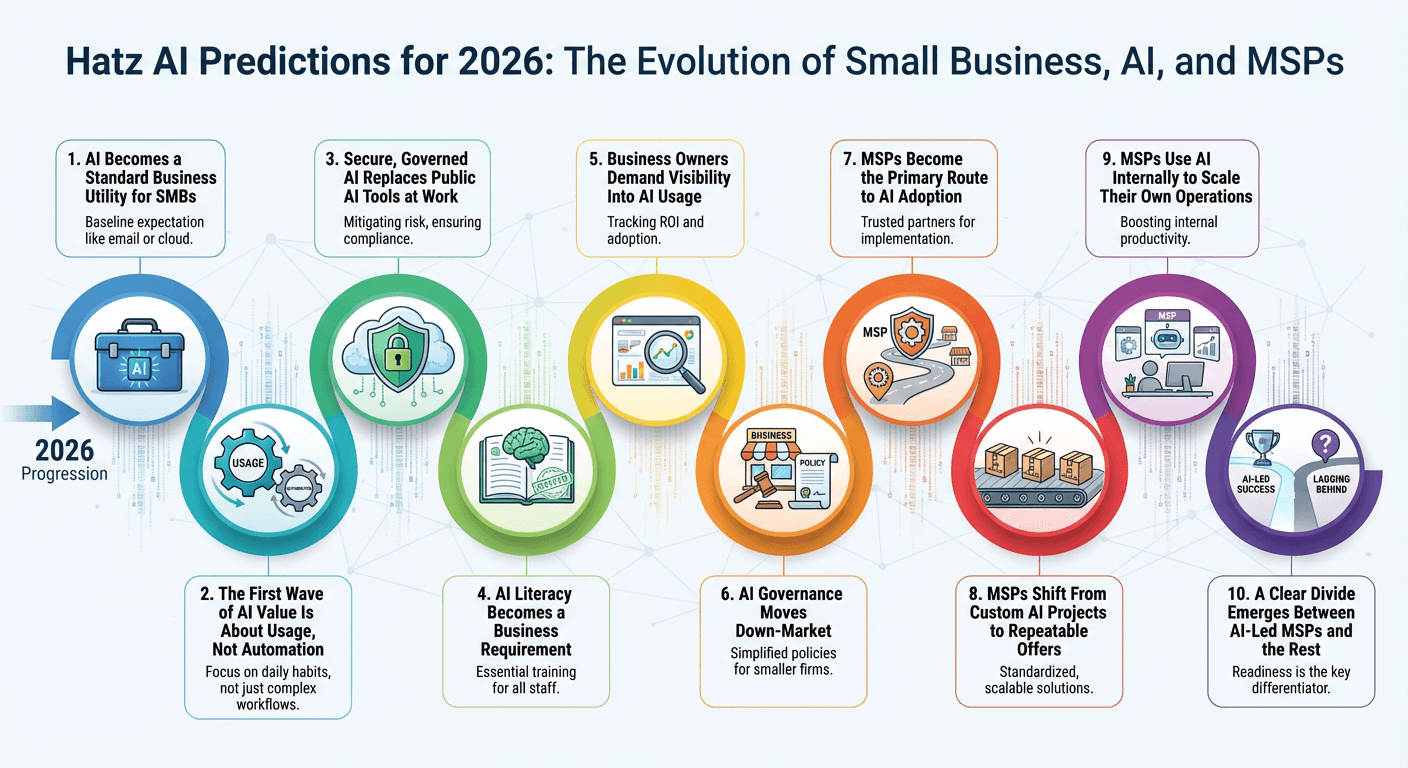
1. AI Becomes a Standard Business Utility for SMBs
By early 2026, AI is no longer viewed as a future initiative. For small businesses, it becomes a baseline expectation—similar to email, cloud services, or cybersecurity.
Employees expect AI tools to help them think, write, analyse, and move faster. Business owners expect productivity gains, not experiments. The question shifts from “Should we use AI?” to “Why isn’t everyone using this properly?”
This marks the point where AI transitions from novelty to necessity.
2. The First Wave of AI Value Is About Usage, Not Automation
Despite headlines about AI agents and advanced workflows, most real value in early 2026 comes from simple, consistent usage.
Small businesses benefit most when employees:
Use AI daily
Apply it to real work
Build confidence and fluency over time
This is a “human + AI” phase, not an automation-first phase. Businesses that focus on habits and usage outperform those chasing complexity too early.
3. Secure, Governed AI Replaces Public AI Tools at Work
As AI use increases, so does awareness of risk.
By 2026, most SMBs recognise that unmanaged use of public AI tools introduces:
Data leakage concerns
Compliance exposure
Zero visibility into usage
The shift is clear: businesses want secure, controlled AI environments designed for work, not experimentation. AI becomes part of the security and governance conversation—not separate from it.
4. AI Literacy Becomes a Business Requirement
Small businesses begin to understand that AI value is constrained by people, not technology.
Low confidence, poor prompting, and inconsistent understanding limit impact. In response, AI literacy becomes standard:
Part of onboarding
Part of ongoing enablement
Comparable to security awareness training
By mid-2026, organisations that invest in basic AI education consistently outperform those that don’t.
5. Business Owners Demand Visibility Into AI Usage
As AI becomes embedded in daily workflows, leadership asks practical questions:
Who is using AI?
Where is it being applied?
Is it actually saving time?
AI usage data becomes the bridge between experimentation and long-term investment. Businesses that can see progress gain confidence to expand usage further.
6. AI Governance Moves Down-Market
In 2026, AI governance is no longer limited to large enterprises.
Small businesses begin adopting:
Simple AI policies
Approved use cases
Guardrails around sensitive data
This isn’t about slowing innovation. It’s about ensuring AI is used responsibly, consistently, and safely as it becomes part of normal operations.
7. MSPs Become the Primary Route to AI Adoption
Small businesses do not want to evaluate dozens of AI tools or manage AI alone.
Instead, they look to MSPs to:
Curate and recommend AI platforms
Ensure security and compliance
Support rollout and adoption
Help teams get real value
By 2026, MSPs are clearly established as the default AI channel for SMBs—not as AI builders, but as trusted operators.
8. MSPs Shift From Custom AI Projects to Repeatable Offers
The MSPs that scale AI successfully move away from bespoke pilots and one-off projects.
Instead, they focus on:
Standardised AI packages
Repeatable onboarding
Consistent rollout across customers
This approach reduces friction, increases adoption, and allows MSPs to grow AI as a managed service rather than a consulting exercise.
9. MSPs Use AI Internally to Scale Their Own Operations
In parallel, MSPs increasingly use AI inside their own businesses to:
Improve service desk efficiency
Speed up documentation and reporting
Support sales and customer success teams
AI becomes a force multiplier internally, enabling MSPs to serve more customers without linear headcount growth.

10. A Clear Divide Emerges Between AI-Led MSPs and the Rest
By the end of the first half of 2026, the gap becomes visible.
On one side:
MSPs with structured AI platforms
Clear adoption paths
Confident customer conversations
On the other:
MSPs still “talking about AI”
Lacking repeatable execution
Struggling to demonstrate value
AI readiness becomes a differentiator, not a future investment.
Final Thought
What defines 2026 is not how advanced AI becomes, but how embedded it is in everyday work.
Small businesses want AI that is:
Easy to use
Secure by default
Supported by someone they trust
MSPs are uniquely positioned to deliver that outcome—by enabling access, driving adoption, and providing governance without complexity.
At Hatz AI, we believe the next chapter of AI adoption will be defined not by hype, but by execution. The MSPs who embrace that reality early will shape the future of AI for small businesses.
Hatz AI Predictions for 2026
Hatz AI
How Small Businesses, AI, and MSPs Will Evolve in the Year Ahead
As we move into 2026, AI adoption is no longer about experimentation or hype. For small businesses—particularly in the U.S.—AI is becoming a practical, everyday capability. At the same time, Managed Service Providers (MSPs) are emerging as the primary way AI is deployed, governed, and sustained inside real organisations.
What’s notable about the next phase of AI adoption is not its technical complexity, but its normalisation. AI is quietly embedding itself into daily work, and MSPs are being asked to make that transition safe, repeatable, and valuable.
Here are Hatz AI’s 10 predictions for 2026, with a particular focus on the first half of the year.
1. AI Becomes a Standard Business Utility for SMBs
By early 2026, AI is no longer viewed as a future initiative. For small businesses, it becomes a baseline expectation—similar to email, cloud services, or cybersecurity.
Employees expect AI tools to help them think, write, analyse, and move faster. Business owners expect productivity gains, not experiments. The question shifts from “Should we use AI?” to “Why isn’t everyone using this properly?”
This marks the point where AI transitions from novelty to necessity.
2. The First Wave of AI Value Is About Usage, Not Automation
Despite headlines about AI agents and advanced workflows, most real value in early 2026 comes from simple, consistent usage.
Small businesses benefit most when employees:
Use AI daily
Apply it to real work
Build confidence and fluency over time
This is a “human + AI” phase, not an automation-first phase. Businesses that focus on habits and usage outperform those chasing complexity too early.
3. Secure, Governed AI Replaces Public AI Tools at Work
As AI use increases, so does awareness of risk.
By 2026, most SMBs recognise that unmanaged use of public AI tools introduces:
Data leakage concerns
Compliance exposure
Zero visibility into usage
The shift is clear: businesses want secure, controlled AI environments designed for work, not experimentation. AI becomes part of the security and governance conversation—not separate from it.
4. AI Literacy Becomes a Business Requirement
Small businesses begin to understand that AI value is constrained by people, not technology.
Low confidence, poor prompting, and inconsistent understanding limit impact. In response, AI literacy becomes standard:
Part of onboarding
Part of ongoing enablement
Comparable to security awareness training
By mid-2026, organisations that invest in basic AI education consistently outperform those that don’t.
5. Business Owners Demand Visibility Into AI Usage
As AI becomes embedded in daily workflows, leadership asks practical questions:
Who is using AI?
Where is it being applied?
Is it actually saving time?
AI usage data becomes the bridge between experimentation and long-term investment. Businesses that can see progress gain confidence to expand usage further.
6. AI Governance Moves Down-Market
In 2026, AI governance is no longer limited to large enterprises.
Small businesses begin adopting:
Simple AI policies
Approved use cases
Guardrails around sensitive data
This isn’t about slowing innovation. It’s about ensuring AI is used responsibly, consistently, and safely as it becomes part of normal operations.
7. MSPs Become the Primary Route to AI Adoption
Small businesses do not want to evaluate dozens of AI tools or manage AI alone.
Instead, they look to MSPs to:
Curate and recommend AI platforms
Ensure security and compliance
Support rollout and adoption
Help teams get real value
By 2026, MSPs are clearly established as the default AI channel for SMBs—not as AI builders, but as trusted operators.
8. MSPs Shift From Custom AI Projects to Repeatable Offers
The MSPs that scale AI successfully move away from bespoke pilots and one-off projects.
Instead, they focus on:
Standardised AI packages
Repeatable onboarding
Consistent rollout across customers
This approach reduces friction, increases adoption, and allows MSPs to grow AI as a managed service rather than a consulting exercise.
9. MSPs Use AI Internally to Scale Their Own Operations
In parallel, MSPs increasingly use AI inside their own businesses to:
Improve service desk efficiency
Speed up documentation and reporting
Support sales and customer success teams
AI becomes a force multiplier internally, enabling MSPs to serve more customers without linear headcount growth.
10. A Clear Divide Emerges Between AI-Led MSPs and the Rest
By the end of the first half of 2026, the gap becomes visible.
On one side:
MSPs with structured AI platforms
Clear adoption paths
Confident customer conversations
On the other:
MSPs still “talking about AI”
Lacking repeatable execution
Struggling to demonstrate value
AI readiness becomes a differentiator, not a future investment.
Final Thought
What defines 2026 is not how advanced AI becomes, but how embedded it is in everyday work.
Small businesses want AI that is:
Easy to use
Secure by default
Supported by someone they trust
MSPs are uniquely positioned to deliver that outcome—by enabling access, driving adoption, and providing governance without complexity.
At Hatz AI, we believe the next chapter of AI adoption will be defined not by hype, but by execution. The MSPs who embrace that reality early will shape the future of AI for small businesses.
Get Started
Join Hatz and put AI to work for your team with faster workflows, smarter decisions, and complete control over your data. No compromises.
Get Started
Join Hatz and put AI to work for your team with faster workflows, smarter decisions, and complete control over your data. No compromises.
Get Started
Join Hatz and put AI to work for your team with faster workflows, smarter decisions, and complete control over your data. No compromises.