NOW AVAILABLE! Launch your AI-as-a-service business with Hatz Activate!
Learn more
NOW AVAILABLE! Launch your AI-as-a-service business with Hatz Activate!
Learn more
NOW AVAILABLE! Launch your AI-as-a-service business with Hatz Activate!
Learn more
The AI Sandwich Model
The AI Sandwich Model
JP Kehoe

Why MSPs Are Becoming the Agent Factories for Modern Business
Over the past year, most conversations about AI in IT services have centered on tools — chatbots, copilots, productivity assistants. Useful stuff, but not the whole story.
Something bigger is unfolding underneath all of it.
AI isn't just changing how software gets built. It's changing how companies actually run. And for MSPs, that shift may be the biggest opportunity this industry has ever seen.
Three Waves, One Bottleneck
The first wave was straightforward: AI helped developers write code faster. More output, same team.
The second wave was predictable: more code meant more to review, secure, and monitor. Security and DevOps teams found themselves buried.
But the third wave is different — and this is where things get genuinely interesting.
The constraint today isn't technology. Engineering teams are shipping new capabilities every week. The bottleneck is the organization trying to absorb it all. Sales, operations, and leadership are still catching up to last quarter while the product keeps moving.
The real limit on AI adoption right now is organizational speed.
The Sandwich
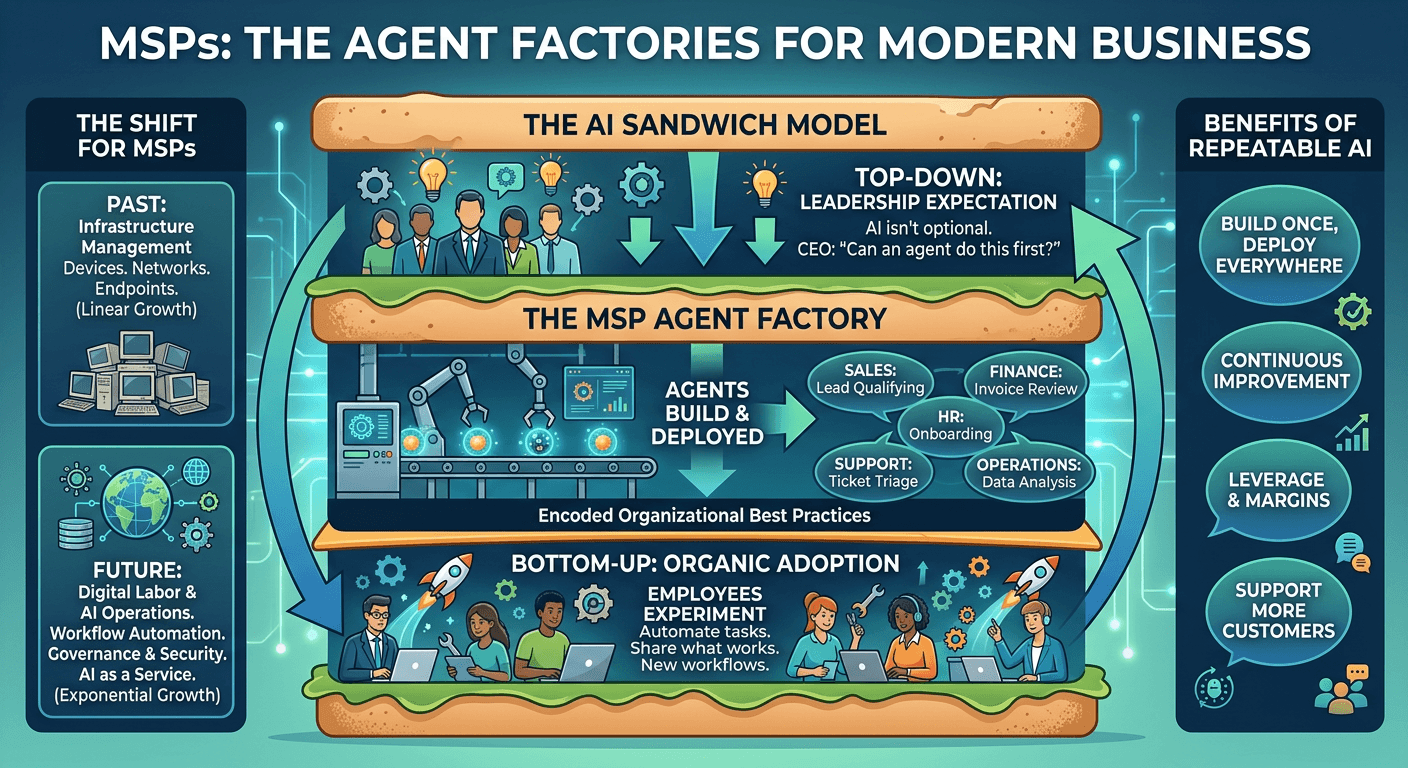
Companies that are actually making AI work have figured out that it has to happen from both directions at once — top down and bottom up.
From the top, leadership has to set the expectation that AI isn't optional. The question "should we hire someone for this?" now has a predecessor: "Can an agent handle it first?" That's not a cost-cutting mindset — it's a resource allocation one. The organizations getting this right are treating AI as a digital workforce, not a feature.
From the bottom, the most durable adoption is organic. Employees experiment, find shortcuts, share what works, and start building habits around tools that actually help them. When that energy gets channeled rather than stifled, things move fast.
When both forces are present — clear direction from leadership and genuine experimentation at the ground level — organizations change quickly. When either one is missing, AI adoption stalls out regardless of how much gets spent on tools.
The Agent Factory
The companies ahead of the curve aren't just using AI. They're building agents — systems that handle actual workflows and responsibilities.
Sales agents qualifying inbound leads. Finance agents reviewing contracts and flagging anomalies. HR agents walking new hires through onboarding. Support agents triaging tickets before a human ever touches them. Operations agents pulling insight out of documents and data.
What starts as automation gradually becomes something more structural. The best practices of the organization get encoded into these agents. Over time, the company essentially becomes a software factory for its own operations — continuously refining how work gets done.
Where MSPs Come In
Most businesses don't have the internal resources to build and govern their own AI infrastructure. They need someone to handle the platform, the integrations, the security and compliance layer, the workflow automation, and the actual agent deployment.
That's the MSP's role.
This isn't a stretch — it's a natural extension of what MSPs already do. The same way MSPs became the backbone of cloud adoption and cybersecurity, they're positioned to become the backbone of AI operations. The trust is already there. The relationships are already there. What's needed now is the capability layer on top.
From Infrastructure to Digital Labor
MSP services have traditionally been about infrastructure. Devices, networks, endpoints. Managing the environment so the business can run.
That model is expanding. The next version of managed services isn't just about keeping the lights on — it's about deploying capability across the customer's organization.
Automating workflows. Running department-specific agents. Governing AI usage and keeping it secure. Helping customers understand where AI is working and where it isn't.
That's a different kind of value than help desk tickets and patch management. It's closer to a strategic operating partner than a vendor.
The Scaling Math Changes
There's also a significant internal advantage for MSPs who embrace this.
Traditionally, growth meant hiring. More customers required more engineers. The math was essentially linear.
AI breaks that equation. With the right systems in place — ticket triage, documentation, reporting, internal knowledge management — MSPs can support meaningfully more customers per engineer. The margin profile changes. The growth ceiling rises.
Build Once, Deploy Everywhere
The MSPs that pull ahead won't be building custom solutions from scratch for every customer engagement. They'll build repeatable agents and workflows and deploy them across their base.
One well-built sales assistant can be rolled out across dozens of customers. A solid finance automation workflow gets reused, refined, and improved with every deployment. The leverage compounds over time.
Build it once. Deploy it everywhere. Get better at it continuously.
That's how MSPs become AI factories — not just for themselves, but for the businesses they serve.
Getting Started
None of this requires a big-bang transformation. The MSPs making the most progress are following a simple sequence:
Use AI inside their own operations first
Pilot with a small group of early-adopter customers
Develop repeatable workflows and agents from what works
Scale across the broader customer base
What starts as a handful of deployments can grow into a meaningful new revenue stream faster than most expect.
What the Next Five Years Look Like
The MSP of 2030 won't just manage IT. It'll manage AI-enabled organizations — deploying capabilities across departments, governing how AI is used, helping customers stay secure, and enabling them to scale in ways that weren't possible before.
The companies that move early on this will have a significant head start. Not because AI is magic, but because the learning curve is real and the compounding advantages are substantial.
The future of this industry isn't just about managing technology. It's about managing how organizations think and operate. The MSPs building toward that today are the ones who'll define what the industry looks like tomorrow.
The AI Sandwich Model
JP Kehoe
Why MSPs Are Becoming the Agent Factories for Modern Business
Over the past year, most conversations about AI in IT services have centered on tools — chatbots, copilots, productivity assistants. Useful stuff, but not the whole story.
Something bigger is unfolding underneath all of it.
AI isn't just changing how software gets built. It's changing how companies actually run. And for MSPs, that shift may be the biggest opportunity this industry has ever seen.
Three Waves, One Bottleneck
The first wave was straightforward: AI helped developers write code faster. More output, same team.
The second wave was predictable: more code meant more to review, secure, and monitor. Security and DevOps teams found themselves buried.
But the third wave is different — and this is where things get genuinely interesting.
The constraint today isn't technology. Engineering teams are shipping new capabilities every week. The bottleneck is the organization trying to absorb it all. Sales, operations, and leadership are still catching up to last quarter while the product keeps moving.
The real limit on AI adoption right now is organizational speed.
The Sandwich
Companies that are actually making AI work have figured out that it has to happen from both directions at once — top down and bottom up.
From the top, leadership has to set the expectation that AI isn't optional. The question "should we hire someone for this?" now has a predecessor: "Can an agent handle it first?" That's not a cost-cutting mindset — it's a resource allocation one. The organizations getting this right are treating AI as a digital workforce, not a feature.
From the bottom, the most durable adoption is organic. Employees experiment, find shortcuts, share what works, and start building habits around tools that actually help them. When that energy gets channeled rather than stifled, things move fast.
When both forces are present — clear direction from leadership and genuine experimentation at the ground level — organizations change quickly. When either one is missing, AI adoption stalls out regardless of how much gets spent on tools.
The Agent Factory
The companies ahead of the curve aren't just using AI. They're building agents — systems that handle actual workflows and responsibilities.
Sales agents qualifying inbound leads. Finance agents reviewing contracts and flagging anomalies. HR agents walking new hires through onboarding. Support agents triaging tickets before a human ever touches them. Operations agents pulling insight out of documents and data.
What starts as automation gradually becomes something more structural. The best practices of the organization get encoded into these agents. Over time, the company essentially becomes a software factory for its own operations — continuously refining how work gets done.
Where MSPs Come In
Most businesses don't have the internal resources to build and govern their own AI infrastructure. They need someone to handle the platform, the integrations, the security and compliance layer, the workflow automation, and the actual agent deployment.
That's the MSP's role.
This isn't a stretch — it's a natural extension of what MSPs already do. The same way MSPs became the backbone of cloud adoption and cybersecurity, they're positioned to become the backbone of AI operations. The trust is already there. The relationships are already there. What's needed now is the capability layer on top.
From Infrastructure to Digital Labor
MSP services have traditionally been about infrastructure. Devices, networks, endpoints. Managing the environment so the business can run.
That model is expanding. The next version of managed services isn't just about keeping the lights on — it's about deploying capability across the customer's organization.
Automating workflows. Running department-specific agents. Governing AI usage and keeping it secure. Helping customers understand where AI is working and where it isn't.
That's a different kind of value than help desk tickets and patch management. It's closer to a strategic operating partner than a vendor.
The Scaling Math Changes
There's also a significant internal advantage for MSPs who embrace this.
Traditionally, growth meant hiring. More customers required more engineers. The math was essentially linear.
AI breaks that equation. With the right systems in place — ticket triage, documentation, reporting, internal knowledge management — MSPs can support meaningfully more customers per engineer. The margin profile changes. The growth ceiling rises.
Build Once, Deploy Everywhere
The MSPs that pull ahead won't be building custom solutions from scratch for every customer engagement. They'll build repeatable agents and workflows and deploy them across their base.
One well-built sales assistant can be rolled out across dozens of customers. A solid finance automation workflow gets reused, refined, and improved with every deployment. The leverage compounds over time.
Build it once. Deploy it everywhere. Get better at it continuously.
That's how MSPs become AI factories — not just for themselves, but for the businesses they serve.
Getting Started
None of this requires a big-bang transformation. The MSPs making the most progress are following a simple sequence:
Use AI inside their own operations first
Pilot with a small group of early-adopter customers
Develop repeatable workflows and agents from what works
Scale across the broader customer base
What starts as a handful of deployments can grow into a meaningful new revenue stream faster than most expect.
What the Next Five Years Look Like
The MSP of 2030 won't just manage IT. It'll manage AI-enabled organizations — deploying capabilities across departments, governing how AI is used, helping customers stay secure, and enabling them to scale in ways that weren't possible before.
The companies that move early on this will have a significant head start. Not because AI is magic, but because the learning curve is real and the compounding advantages are substantial.
The future of this industry isn't just about managing technology. It's about managing how organizations think and operate. The MSPs building toward that today are the ones who'll define what the industry looks like tomorrow.
Get Started
Join Hatz and put AI to work for your team with faster workflows, smarter decisions, and complete control over your data. No compromises.
Get Started
Join Hatz and put AI to work for your team with faster workflows, smarter decisions, and complete control over your data. No compromises.
Get Started
Join Hatz and put AI to work for your team with faster workflows, smarter decisions, and complete control over your data. No compromises.